Tuesday, January 26, 2021


Question 1:

Why is the atmosphere essential for life?

Answer 1:

The atmosphere is essential for life because it maintains an appropriate climate for the sustenance

of life by carrying out the following activities:

(i) Atmosphere keeps the average temperature of the Earth fairly constant during day time.

(ii) It prevents a sudden increase in temperature during day time.

(iii) It also slows down the escape of heat from the surface of the Earth into outer space during

nighttime.

Question 2:

Why is water essential for life?

Answer 2:

Water is essential for life because of the following reasons:

(i) Most biological reactions occur when substances are dissolved in water. Thus, all cellular

processes need water as a medium to take place.

(ii) Transportation of biological substances needs water as a medium.

Question 3:

How are living organisms dependent on the soil? Are organisms that live in water totally

independent of soil as a resource?

Answer 3:

Almost all living organisms are dependent on soil. Some depend directly, while some depend

indirectly. Plants need soil for getting support as well as nutrients to prepare their food. On the

other hand, organisms depend on plants for food and other substances that are essential for life.

Herbivores depend directly upon plants, and carnivores depend upon animals, which in turn

depend upon plants for food. This makes them depend on soil indirectly. Organisms that live in

water are not totally independent of soil as a resource. These organisms depend on aquatic plants

for food and other substances. These aquatic plants in turn require minerals for their sustenance.

These minerals are carried to water bodies from soil by rivers, rain water, etc. Without the supply

of minerals from the soil to the water bodies, it is impossible to imagine aquatic life.

Question 4:

You have seen weather reports on television and in newspapers. How do you think we are able to

predict the weather?

Answer 4:

The meteorological department of the government collects data on the elements of weather such

as maximum and minimum temperatures, maximum and minimum humidity, rainfall, wind speed,

etc. They are able to study these elements using various instruments. The maximum and minimum

temperature of a day is measured by a thermometer known as the maximum−minimum

thermometer. Rain fall is measured by an instrument known as the rain gauge. Wind speed is

measured by anemometers. There are various instruments used to measure humidity.

Question 5:

We know that many human activities lead to increasing levels of pollution of the air, water-bodies

and soil. Do you think that isolating these activities to specific and limited areas would help in

reducing pollution?

Answer 5:

Yes. Isolating human activities to specific areas would help in reducing levels of pollution. For

example, setting up of industries in isolated regions will control pollution to some extent. The

pollution caused by these industries will not contaminate water resources, agriculture land, fertile

land, etc.

Question 6:

Write a note on how forests influence the quality of our air, soil and water resources.

Answer 6:

Forests influence the quality of our air, soil, and water resources in various ways. Some of them

are:

(i) Forests balance the percentages of carbon dioxide and oxygen in the atmosphere. The

increasing amount of carbon dioxide caused by human activities is balanced by a larger intake of

carbon dioxide by plants during the process of photosynthesis. Simultaneously, a large amount of

oxygen is released.

(ii) Forests prevent soil erosion. Roots of plants bind the soil tightly in a way that the surface of

the soil cannot be eroded away by wind, water, etc.

(iii) Forests help in the replenishment of water resources. During the process of transpiration, a

huge amount of water vapour goes into the air and condenses to form clouds. These clouds cause

rainfall that recharge water bodies.

 Question 1:

What are the different states in which water is found during the water cycle?

Answer 1:

During the water cycle, water is found in solid state (snow, ice, etc.), liquid state (ground water,

river water, etc.), and gaseous state (water vapours).

Question 2:

Name two biologically important compounds that contain both oxygen and nitrogen.

Answer 2:

Two biologically important compounds that contain both oxygen and nitrogen are:

(i) Amino acids

(ii) Deoxyribonucleic acid (DNA) and Ribonucleic acid (RNA)

Question 3:

List any three human activities which would lead to an increase in the carbon dioxide content of air.

Answer 3:

(i) Burning of fuels in various processes like heating, cooking, transportation, and industry.

(ii) Human induced forest fires.

(iii) The process of deforestation includes the cutting down of trees. This decreases the uptake of

carbon dioxide for photosynthesis. Eventually, the content of carbon dioxide increases.

 Question 4:

What is the greenhouse effect?

Answer 4:

Some gases like carbon dioxide, methane, nitro us oxide prevent the escape of heat from the

Earth’s surface by trapping it. This increases the average temperature of the Earth. This is called the greenhouse effect. An increase in the content of such gases would lead to a situation of global warming.

Question 5:

What are the two forms of oxygen found in the atmosphere

Answer 5:

The two forms of oxygen found in the atmosphere are:

(i) Diatomic molecular form with chemical formula O2.

(ii) Triatomic molecular form with chemical formula O3 known as ozone


 Question 1:

How is soil formed?

Answer 1:

Soil is formed by breaking down of rocks at or near the surface of the Earth through various physical, chemical, and biological processes by various factors such as the sun, water, wind and living organisms.

(i) Sun: During day time, the rocks are heated. This causes the rocks to expand. During night time, these rocks cool down and contract. Since all parts of the rock do not undergo expansion and contraction at the same rate, this causes the formation of cracks in these rocks. These cracks lead to the breaking up of huge rocks into smaller pieces.

(ii) Water: Water catalyses the process of formation of soil in two ways.

        (a) Water goes into the cracks and crevices formed in the rocks. When this water freezes, its volume increases. As a result, the size of the cracks also increases. This helps in the weathering of rocks.

        (b) Running water wears away hard rocks over long periods of time. Water moving in fast speed carries big and small particles of rock downstream. These rocks rub against each other, resulting in breaking down of rocks. These smaller particles are carried away by running water and deposited down its path.

(iii) Wind: Strong winds carry away rocks, which causes rubbing of rocks. This results in the breaking down of rocks into smaller and smaller particles.

(iv) Living organisms: Some living organisms like lichens help in the formation of soil. Lichens also grow on rocks. During their growth, lichens release certain substances, which cause the rock surface to powder down forming a thin layer of soil. On this thin layer of soil, some small plants like moss also grow. They further cause the breaking down of the rock particles.

Question 2:

What is soil erosion?

Answer 2:

The blowing away or washing away of land surface by wind or water is known as soil erosion.

Question 3:

What are the methods of preventing or reducing soil erosion?

Answer 3:

The methods of preventing or reducing soil erosion are:

(i) Prevention of deforestation

(ii) Plantation of trees


 Question 1:

Why do organisms need water?

Answer 1:

Organisms need water for the following reasons:

(i) All cellular processes need water as a medium. Usually, the reactions that take

place in our body or within the cells occur between substances that are dissolved in water.

(ii) Since most of the substances are transported in a dissolved form, water is necessary.

Question 2:

What is the major source of fresh water in the city/town/village where you live?

Answer 2:

River is a major source of fresh water.

Question 3:

Do you know of any activity which may be polluting this water source?

Answer 3:

The discharge of waste water from homes, industries, hospitals, etc. into the river pollutes this

fresh water source.

 Question 1: How is our atmosphere different from the atmospheres on Venus and Mars? 

Answer 1: Earth’s atmosphere is different from those of Venus and Mars. This difference lies essentially in their compositions. Earth’s atmosphere is a mixture of nitrogen (79%), oxygen (20%), and a small fraction of carbon dioxide, water vapours and other gases. This makes the existence of life possible on Earth. However, the atmospheres on Venus and Mars mainly consist of carbon dioxide. The amount of carbon dioxide on these planets can range from 95% to 97%. 

Question 2: How does the atmosphere act as a blanket? 

Answer 2: The atmosphere acts as a blanket by performing the following functions: 

(a) It keeps the average temperature of the Earth fairly constant during day time and even during the course of whole year. (b) It prevents a sudden increase in the temperature during day time. (c) It slows down the escape of heat from the surface of the Earth into outer space during night time. 

Question 3: What causes winds? 

Answer 3: An uneven heating of the Earth’s surface causes winds. On being heated, air becomes lighter and rises up. As a result, a region of low pressure is created. Then, air from a high pressure region moves to a low pressure region, causing wind.

Question 4: How are clouds formed? 

Answer 4: During day time, on being heated, a large amount of water evaporates from various water bodies and goes into the air. A part of this water vapour also reaches the atmosphere through biological activities such as transpiration and respiration. This causes the air in the atmosphere to heat up. When this heated air rises, it expands and cools, which results in the condensation of water vapour forming water droplets. The presence of dust and other suspended particles in air also facilitates the process of condensation. The formation of water droplets leads to the formation of clouds. 

Question 5: List any three human activities that you think would lead to air pollution. 

Answer 5: The following three human activities would lead to air pollution: 

(i) Burning of fossil fuels such as coal and petroleum 

(ii) Industrialization 

(iii) Deforestation


Sunday, June 14, 2020

1   -Footprints without Feet

                                                (H.G Wells)


Foot Prints without feet Soft Cybers

Q1:- How would you assess Griffin as a scientist?

Ans: Griffin was a successful scientist. He carried out experiment after experiment to prove that human body could become invisible. At last he discovered a rare drug which could make human body as transparent as a sheet of glass.

 Q2:-The Two boys in London were surprised and fascinated. Why?

Ans: The two boys got fascinated and surprised when they saw muddy imprints of a bare footed man. But they could see no man there. The Imprints became fainter and fainter and at last disappeared altogether.­

Q3:- What did Griffin do inside a shop?

Ans: When Griffin entered the shop, he was shivering with cold. He broke out boxes and fitted himself with warm clothes. He also found shoes, an overcoat and a hat. He took coffee and ate meat. Finally, he slept on a pile of quilts.

Q4:- How did Griffin escape from London store?

Ans: Griffin did not wake up until the assistants already arrived next morning. He began to run when he saw couple of  them approaching him. In the end, he was able to escape only by taking off his newly found clothes.

Q5:- Griffin entered the shop of a theatrical company. What did he do there?

Ans: Griffin found clothes for himself. He also found things to hide his empty face. He found bandages to wear round his forehead. He found dark glasses, a false nose and a large hat. Then he hit the shopkeeper and ran away with his money.

Q6:- Why  was the arrival of the stranger in a village inn an unusual event. Give two reasons?

Ans: The stranger had come to the village inn in winter when nobody ever came. Secondly his appearance was unusual. Thus, the stranger’s arrival was an unusual event.

Q7:- How did the scientist look when he came to the inn?

Ans: The scientist looked uncommon when he came to the inn. He had bandages round his forehead. He was wearing dark glasses, false nose, big bushy whiskers and a large hat.

Q8:- The landlord’s wife was convinced that Griffin was an eccentric scientist. What made her think of Griffin in these terms?

Ans: Griffin had come to the village inn in winter when nobody visited the place. Besides he always wore bandages on his forehead. He never talked to anyone. All this convinced Mrs. Hall that her guest was an eccentric scientist.

Q9:- What was the curious episode that took place in the clergyman’s study?

Ans: One day clergyman and his wife were awakened by noises in the study. They heard a chink of money. Without making any noise the clergyman opened the door and to his amazement the room appeared empty and the money was missing. Thus it was a curious thing.

 Q10:- The landlord and his wife were surprised to see  the scientist’s door wide open. Why were they surprised? What extraordinary things happened in the room?

Ans: The landlord and his wife were surprised to see the scientist’s door wide open because it was always shut and locked. The scientist was furious if anyone entered his room. They found the opportunity too good to be missed.

                They entered the room to investigate but all of sudden Mrs Hall heard a sniffclose to her ear. A moment later the hat on the bedpost leapt up and dashed into the face of Mrs Hall. Then the bedroom chair became alive and rose up in the air and pushed both of them out of room.

Q11:- Mrs Hall almost fell down the stairs in hysterics. Pick out an example of humour from what follows this incident?

Ans: Mrs Hall was in Griffin’s room. A hat leapt up and dashed into her face, then the bedroom chair became alive and rose up in the air and pushed both of them out of room.Mrs Hall thought her mother’s spirit had entered the chair. But we know it was Griffin who was doing all that.

Q12:- The scientist was furious. What did he do in anger? Why were the people in the bar horrified?

Ans: The scientist threw off his bandages. He removed his whiskers, glasses and false nose. Now, he looked a headless person. When the people in bar saw him, they were horrified to see a headless person in front of them.

Q13:- What happened to the constable?

Ans: Mr. Jaffers, the constable tried to catch the scientist. The scientist took off his clothes one by one. He became invisible. He began to hit the constable. But the constable could not see the blows. He fell down unconscious.

Q14:- The scientist was a man of “irritable temper”. Give an example to prove this.

Ans: The scientist was a man of “ irritable temper”. Mrs Hall tried to be friendly with him but he refused her to talk and told her that he had come there only for solitude and he should not be disturbed

NOTICE

20 April 2020

Syed Jalal-ud-Din Memorial School 

INTER SCHOOL DEBATE COMPETITION


An inter-school-debate competition is going to be held in our school on 28 March 2019. The topic of debate will be “ Aliens can invade the earth”. Students of class VIII to X can take part in the debate. Those who are willing to participate should give their names to the undersigned by or before 24th of this month.


QUIRAT-UL-AIN

( secretary )

Saturday, June 13, 2020

Monday, May 18, 2020

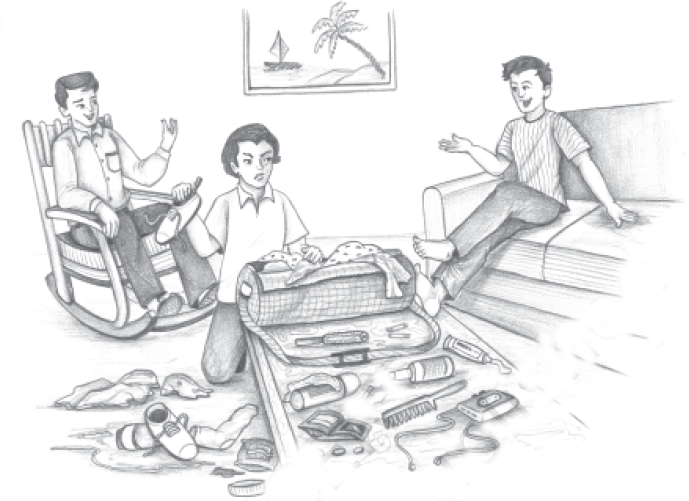
packing
Add caption


Lesson No. I English 9th 
Thinking About The Text

Q1. How many characters are there in the narrative? Name them. (Don’t forget the dog!).
Ans. There are four characters in the narrative. The names of these characters are:
1. Jerome Klapka Jerome, 2. Haris, 3. George, and 4. Montmorency, a Dog 

Q2. Why did the narrator (Jerome) volunteer to do the packing?
Ans. The narrator Jerome loved packing and was proud on his own packing. He was thinking to direct Haris and George for packing like a boss but as they knew nothing about the packing so he volunteered himself to do it.
Q3. How did George and Harris react to this? Did Jerome like their reaction?
Ans. George and Haris sat still watching Jerome while packing. That irritated Jerome, because he did not like seeing other people sitting about doing nothing while he worked.
Q4. What was Jerome’s real intention when he offered to pack?
Ans. Jerome intended that he should boss the job and Haris and George would potter about under his directions.
Q5. What did Harris say after the bag was shut and strapped? Why do you think he waited till then to ask?
Ans. After the bag was shut and strapped Haris asked him whether he was not going to put his boots in the bag. The were trying to make him uncivilized and wild so that they could laugh on him.
Q6. What “horrible idea” occurred to Jerome a little later?
Ans. When Jerome was about to close his packing, a horrible idea occurred to him whether he had packed his toothbrush or not.
Q7. Why did Jerome have to reopen the packed bag?
Ans. Jerome had to reopen his packed bag because he had packed his tobacco-pouch in it.
Q8. What does Jerome say was Montmorency’s ambition in life? What do you think of Montmorency and why?
Ans. Montmorency’s ambition in life was to interfere in others work and be cursed by them. His day was perfect only when he had been beaten on his head. Montmorency was the name of the dog. Montmorency in the lesson behaves like a mad dog that sits on the things when they are going to be packed but that is natural for a dog to do such things.
Q9. Of the three, Jerome, George and Harris, who do you think is the best or worst packer? Support your answer with details from the text.
Ans. From the lesson, we can say that Gerome is the best packer although he forgot many things to pack and had to reopen it many times. Narrator, himself says that Haris is the worst packer. Haris and George did some odd things while packing. Haris packed a strawberry jam on top of tomato and quashed it. George stepped on the butter. They packed pastries at the bottom and put heavy things on it.
Q10. How did Montmorency ‘contribute’ to the packing?
Ans. Montmorency made the packing more complicated for them. He sometime, either sat down on the packing things or put his leg in the jam bottle. Anyhow, he increased their labour.
Q11. Do you find this story funny? What are the humorous elements in it? (Pick out at least three; think about what happens, as well as how it is described.)
Ans. The story is full of fun. There are many instances where humorous elements are used. Packing strawberry jam bottle on top of tomato and quashing it and then removing the tomato juice with spoon, is funny instance. Second instance is putting slipper in the kettle and the third one is about the dog, who puts his leg in the jam bottle and pretends tomatoes as rats and kills them.
Language work
Papaya is the healthiest fruit with a list of properties that is long and exhaustive. Belonging to the family of Caricaceae fruit, it is commonly known as Papaw in Australia and Mamao in Brazil. It first originated in southern Mexico and neighboring Central America, but is now available in every tropical and subtropical country. Papaya favours digestion as well as cures skin irritation and sun burns. You can munch on it as a salad, have it cooked or boiled or just drink it up a milkshake or juices. Modern science confirms the age-old beliefs that papaya has much to contribute to the health cause. The most important of these virtues is the protein digesting enzyme in the milky juice or latex. The enzyme is like pepsin in its digestive action and is said to be so powerful that it can digest 200 times its own weight in protein. It assists the body in assimilating the maximum nutritional value from food to provide energy and body building materials.
Papain in raw papaya makes up for the deficiency of gastric juice and fights excess of unhealthy mucus in the stomach, dyspepsia and intestinal irritation. The ripe fruit, if eaten regularly corrects habitual constipation, bleeding piles and chronic diarrhea. The juice of the papaya seeds also assists in the above-mentioned ailments.
The juice used as a cosmetic, removes freckles or brown spots due to exposure to sun light and makes the skin smooth and delicate. The paste of papaya seeds is applied in skin diseases like those caused by ringworm. The black seeds of the papaya are highly beneficial in the treatment of cirrhosis of the liver caused by alcoholism, malnutrition, etc. a tablespoonful of its juice, combined with a mint of fresh lime juice, should be consumed once or twice daily for a month. The fresh juice of raw papaya mixed with honey can be applied over inflamed tonsils, for diphtheria and other throat disorders. It dissolves the membrane and prevents infection from spreading.
Complete the following
The other names for papaya are ………….
Though now found in every tropical country, Papaya fruit originated in …………...
One of the most important virtues of papaya is ………….
Intestinal irritation can be overcome …………...
Diseases cured by papaya are………….
Throat disorders can be cured ……………
Ans. The other names for papaya are Papaw and Mamao.
Though now found in every tropical country, Papaya fruit originated in southern Mexico and neighboring Central America.
One of the most important virtues of papaya is the protein digesting enzyme in the milky juice or latex.
Intestinal irritation can be overcome with the papain in raw papaya.
Diseases cured by papaya are ringworm, tonsils, diphtheria chronic diarrhea, bleeding piles, constipation etc.
Throat disorders can be cured with the fresh juice of raw papaya mixed with honey
Ringworm is cured by Papaya juice/Papaya seeds/Papaya fruit/raw papaya. Tick mark the correct answer.
Ans. Papaya seeds
Click for Free NCERT Solutions for Class 8th Social Science
Subscribe to My YouTube Channel ….Here
I. Match the words/phrases in Column A with their meanings in Column B.
Column (A)                                          Column (B)
1. Slaving                                  (i) a quarrel or an argument
2. Chaos                                    (ii) remove something from inside another thing using a sharp tool
3. Rummage                              (iii) strange, mysterious, difficult to explain
4. Scrape out                              (iv) finish successfully, achieve
5. Stumble over                          (v) search for something by moving things around hurriedly or carelessly
6. Accomplish                            (vi) complete confusion and disorder
7. uncanny                                 (vii) fall, or step awkwardly while walking
8. (to have or get into) a row        (viii) working hard
Ans.
Column (A)                                          Column (B)
1. Slaving                                  (viii) working hard
2. Chaos                                    (vi) complete confusion and disorder
3. Rummage                              (v) search for something by moving things around hurriedly or carelessly
4. Scrape out                              (ii) remove something from inside another thing using a sharp tool
5. Stumble over                          (vii) fall, or step awkwardly while walking
6. Accomplish                            (iv) finish successfully, achieve
7. uncanny                                 (iii) strange, mysterious, difficult to explain
8. (to have or get into) a row        (i) a quarrel or an argument
II. Use the following phrases in your own sentences.
Ans.
Toss for            :           The three friends tossed for the beds to sleep.
Toss about       :           We tossed about the new plans for our business.
Fall into           :           He has fallen into the swimming pool.
Fall out            :           Some of the pages have fallen out of the book.
Search for        :           The student is searching for the lost pen.
Scrape out       :           He scraped out the skin of watermelon with a sharp spoon.
Mess about      :           I spent hours messing about on my computer.


Class 9th Lesson No. 2 Subject English

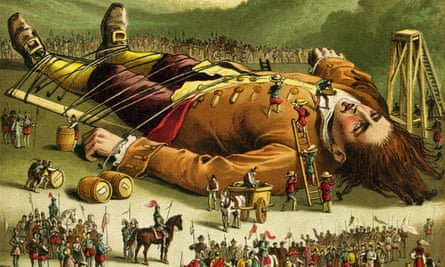
The 100 best novels, No 3 – Gulliver's Travels by Jonathan Swift ...
Thinking About the Text
 Q1. Why did Reldresal visit Gulliver?
Ans. Reldresal was the Chief Secretary for Private Affairs. He visited Gulliver to discuss about the problems of the state, created by two political parties. The Country was in great threat from external danger, so the King need his help for defence.
Q2.  How did Gulliver receive Reldressal?
Ans. Gulliver received him with honour and offered him to lie down, so that he could properly speak to him, but Reldresal preferred to be held in hand during their conversation.

Q3.  What were the two political parties in Lilliput? What was their difference?
Ans. High Heels and Low Heels were the two political parties in Lilliput. These parties were differentiated by the heels of their shoes, they wore. The party, that wore shoes of high heels was called as High Heels party and the party  with low heel shoes was called as Low Heel party.
Q4. Why was the Government in the hands of the Low Heels though they were less numerous than the High Heels?
Ans. The government was in the hands of Low Heels because the Emperor was in favour of Low heels and himself wore low heel shoes.
Q5. What was the external danger that the country had to face?
Ans. The invasion from the Blefuscu was the external danger, that the country had to face. Blefuscu was the other great empire of the universe.
Q6. What was the question of religious principle that gave rise to the war between Lilliput and Blefuscu?
Ans. The religious principle that gave rise to the war between two countries was, whether one should break an egg at the bigger end or at the smaller end. The ancient practice of the course was to break it at the bigger end.
Q7. Why was the ancient way of breaking an egg prohibited in Lilliput?
Ans. The ancient way of breaking an egg was prohibited because the emperor’s grandfather happened to cut his finger, when he was a boy, while breaking an egg at the bigger end.
Q8. How did the people take the new law?
Ans. There was a bitter opposition to the new law, and there were frequent rebellions on account of it, which resulted in the death of thousands of people.
Q9. What was the Emperor of Blefuscu’s part in the internal troubles of Lilliput?
Ans. After the imposition of new law many rebels escaped to Blefuscu, the Emperor of Blefuscu gave them his sympathy and encouragement, thus interfering in the internal affairs of Lilliput. He also charged Lilliputian Emperor of making people to disobey the old teaching of their religion.
Q10. What was the teaching of their ancient religion about the right way of breaking eggs?
Ans. The teaching of their ancient religion about the right way of breaking eggs was that ‘all believers should break their egg at the convenient end’. This teaching was given in the 54th chapter of their holy book.
11. What, in Reldressal opinion, was the meaning of teaching?
Ans. In Reldresal’s opinion, there was a question for each man to decide, which was the convenient end, to break an egg.
Q12. What did Gulliver promise to do for the Emperor?
Ans. Gulliver promised the Emperor to defend his honour and the honour of the country, if there was any kind of invasion from the Blefuscu.
 Language Work
 a) Use the following phrases in your own sentences
Wait upon: The Emperor waited upon till the reply came from the scout.
Carry out: He honestly carried out all the tasks of his lord.
Attend on: The house owner himself attended on his all guests.
Depend on: Students always depend on the dictionary to find the meaning of new words.
Discuss with: He discussed his problems with his best friends.
Engage in: While the employees were suffering a lot, the government was engaged in elections.
Engage with: His marriage was engaged with a beautiful girl.
Charge with: He charged the Emperor with causing divisions in religion among people.
Prefer to: Most of the people of Kashmir prefer to be with Pakistan.
On account of: He was released on account of being an innocent.
b) Give the adjectives of the following nouns and use them in your own sentences:
Attention: Attending – The doctor is attending his patients regularly.
Basic: Basic – A Clerk needs a basic knowledge of computers for office work.
Convenience: Convenient – The college in the middle of the area is convenient to all the students for higher studies.
Empire: Empirical – He made an empirical statement of, teaching only the children of high-class families.
Majesty: Majestic – Taj Mahal is a majestic building in the world.
Honour: Honourable – PM is considered as an honourable person in the country. His honourable statements are praised by all.
Opposition: Opposite – He always have an opposite attitude towards other religions.
Religion: Religious – One cannot play with the religious sentiments of the other.
Sympathy: Sympathetic – He is more sympathetic towards poor people.
Invasion: Invasive – Influenza is more invasive than any other communicable diseases.
c) Use the following words as nouns and verbs in your own sentences
Charge:
Noun: He tried to charge the batteries but they were dead.
Verb: He was charged of being taking bribe from his own employee.
Converse:
Noun: He had a private conversation with his friend.
Verb: Reldresal conversed with Gulliver about their private affairs in the country.
Divide:
Noun: They tried a lot to divide people in the name of religion but people cannot accept this division.
Verb: British divided people by applying divide and rule policy.
Honour:
Noun: We should love and honour each other. He is a man of honour, as never breaks his promises.
Verb: Mr. Naik was honoured with noble prize in his great work towards students.
Principle:
Noun: A man of principles avoids politics.
Verb: He was respected by his officer on his principled behavior.
Rebel:
Noun: Many rebels escaped to other countries during the war.
Verb: They rebelled against the new law imposed by the government.
Report:
Noun: This kind of report is suspicious to us, so we cannot take any action on this report.
Verb: The informers reported that the enemies are ready for the invasion.

Powered by Blogger.

www.Softcybers.com

This blog is solely created to help students , teachers, and others.

Featured Post

The Shadow : Class 5th Poem

The Shadow       class 5th poem Reading is Fun Q.1. Who is the speaker of the poem? Ans: A little boy is the speaker of the poem. Q....

Followers

Search This Blog

Search This Blog

BTemplates.com

Pages

BTemplates.com

Popular Posts